Cipher Visualizers home

Category

Message Authentication Codes

6 articles in this category.

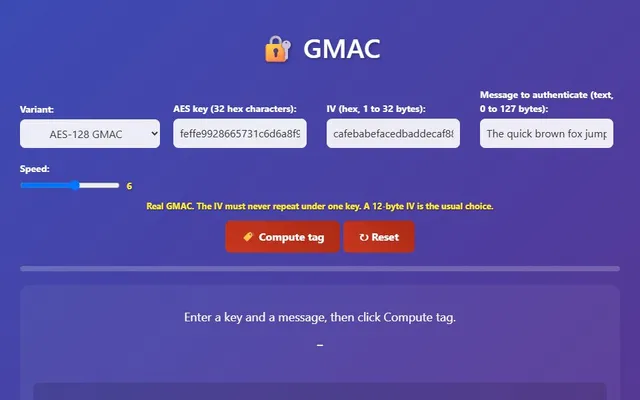
A visual representation of the GMAC Algorithm
Message Authentication Codes Advanced

The GMAC Algorithm

GMAC is the authentication-only mode of AES-GCM. It authenticates data with a polynomial hash over the field GF(2^128), masked by an AES-encrypted counter. Learn how GHASH works, why an IV must never repeat, and how a repeated IV reveals the hash key.

20 min read
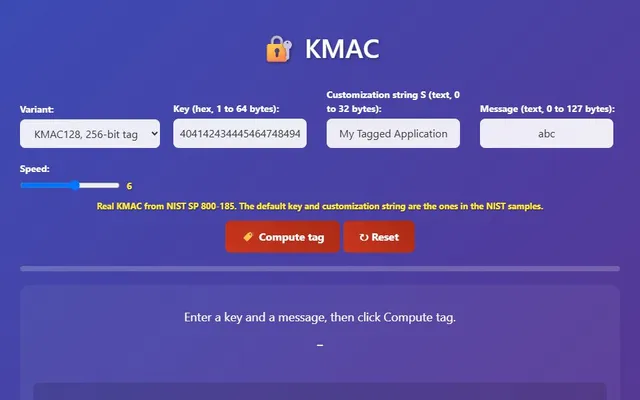
A visual representation of the KMAC Algorithm
Message Authentication Codes Advanced

The KMAC Algorithm

KMAC is the message authentication code built on SHA-3. It needs no HMAC-style double hashing, because the Keccak sponge resists length extension. Learn how cSHAKE, the key block, and the encoded output length work, with every NIST sample checked.

17 min read

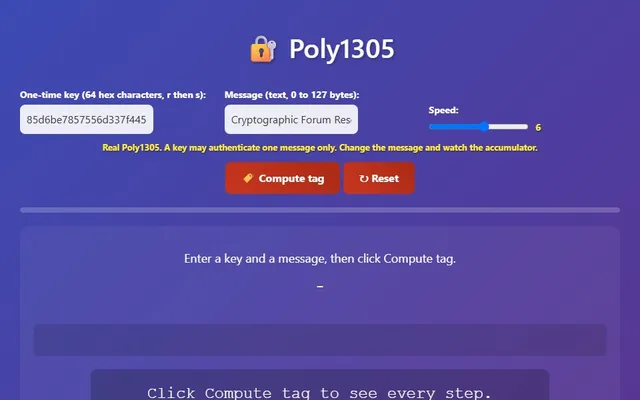
A visual representation of the Poly1305 Algorithm
Message Authentication Codes Intermediate

The Poly1305 Algorithm

Poly1305 is a fast one-time message authentication code that evaluates a polynomial modulo 2^130 - 5. Learn how its key is clamped, how each block joins the accumulator, why a key must never be reused, and how an attacker could recover it if it were.

14 min read

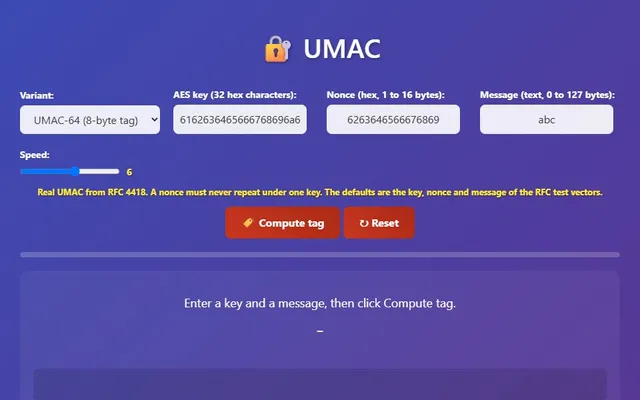
A visual representation of the UMAC Algorithm
Message Authentication Codes Advanced

The UMAC Algorithm

UMAC is a very fast message authentication code built on universal hashing. A three-layer hash shrinks the message, and an AES-made pad hides the result. Learn how NH, POLY, and the inner product work, and how forging odds of 2^-30 to 2^-120 are guaranteed.

20 min read

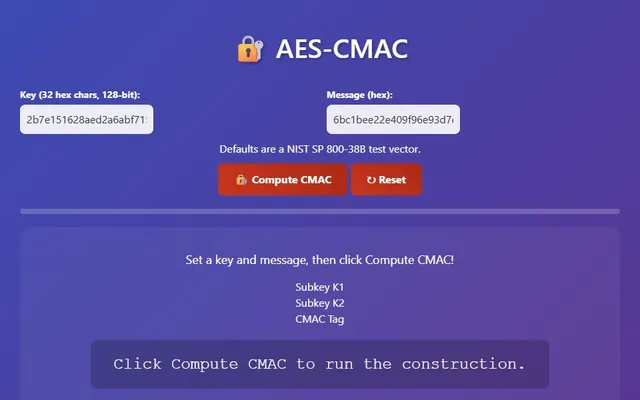
A visual representation of the CMAC Algorithm
Message Authentication Codes Intermediate

CMAC: Cipher-Based Message Authentication

What if you already have AES in your system and don't want to bring in a separate hash function just for message authentication? CMAC builds a MAC directly from a block cipher instead.

9 min read

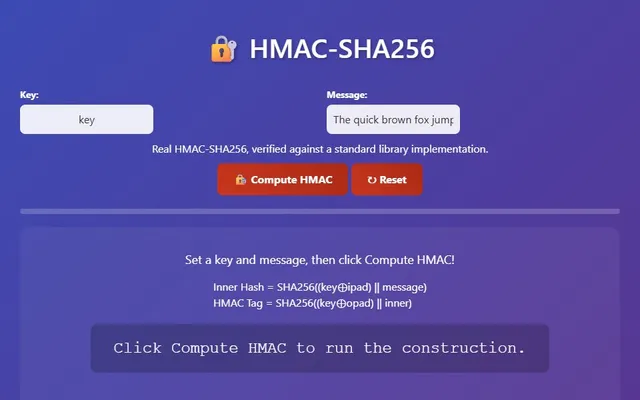
A visual representation of the HMAC Algorithm
Message Authentication Codes Beginner

HMAC: Hash-Based Message Authentication

A hash alone can't prove a message wasn't tampered with. Anyone can recompute it. HMAC fixes that by mixing in a secret key, becoming one of the most quietly essential building blocks in TLS, SSH, and beyond.

8 min read

← All categories