Cipher Visualizers home

Category

Modern Asymmetric Algorithms

9 articles in this category.

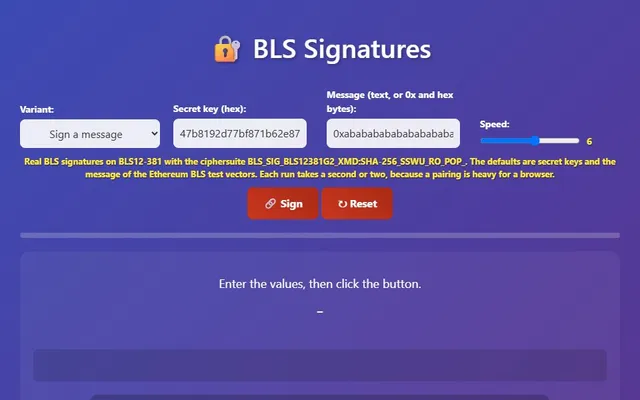
A visual representation of the BLS signature scheme
Modern Asymmetric Algorithms Advanced

BLS Signatures

BLS signatures use a bilinear pairing on the curve BLS12-381 to make short, deterministic signatures that can be added together into one. Learn how a pairing works, how a message is hashed to a curve, how aggregation saves space, and how a rogue key attack is stopped.

39 min read
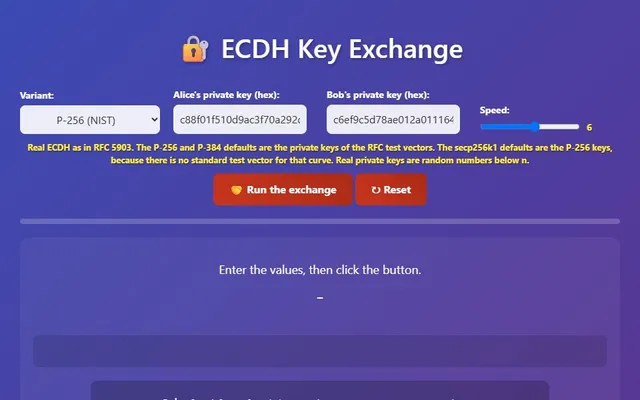
A visual representation of the ECDH key exchange
Modern Asymmetric Algorithms Advanced

Elliptic Curve Diffie-Hellman (ECDH)

ECDH lets two parties agree on a shared secret using points on an elliptic curve. Learn how P-256, P-384, and secp256k1 define the group, how public keys are encoded and validated, why the secret is only an x coordinate, and how an invalid-curve attack works.

23 min read

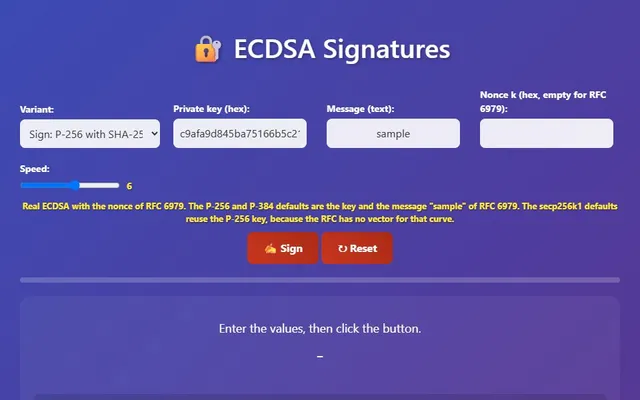
A visual representation of the ECDSA signature algorithm
Modern Asymmetric Algorithms Advanced

ECDSA: Elliptic Curve Digital Signature Algorithm

ECDSA is the elliptic curve version of DSA, used to sign TLS handshakes and Bitcoin transactions. Learn how signing and verifying work, why a repeated nonce reveals the private key, how RFC 6979 removes that risk, and how a signature is encoded.

23 min read

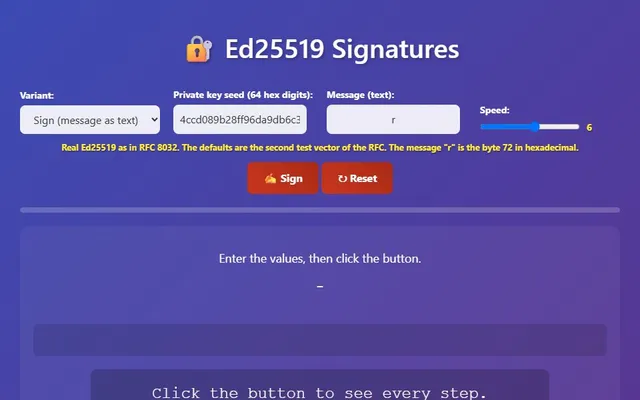
A visual representation of Ed25519 signatures
Modern Asymmetric Algorithms Advanced

Ed25519 Signatures

Ed25519 is the EdDSA signature scheme on the Edwards curve of Curve25519, defined in RFC 8032. Learn how a 32-byte seed becomes a key, how a deterministic nonce replaces random numbers, how a signature is checked with the cofactor, and why the range check on S matters.

19 min read

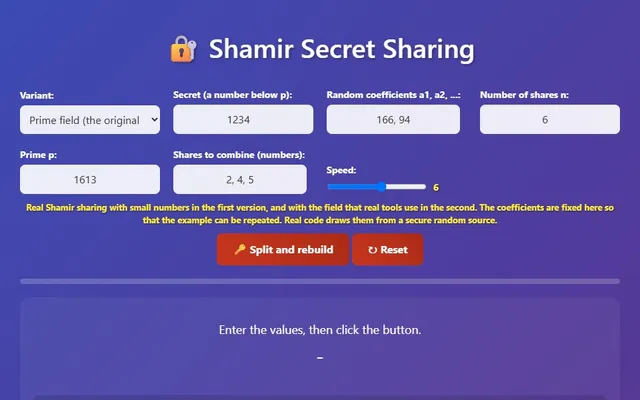
A visual representation of Shamir's Secret Sharing
Modern Asymmetric Algorithms Intermediate

Shamir's Secret Sharing

Shamir's secret sharing splits a secret into shares so that any k of n shares rebuild it and fewer reveal nothing at all. Learn how a polynomial hides the secret, how Lagrange interpolation recovers it, why k minus one shares give no information, and how GF(256) makes the scheme work on bytes.

20 min read

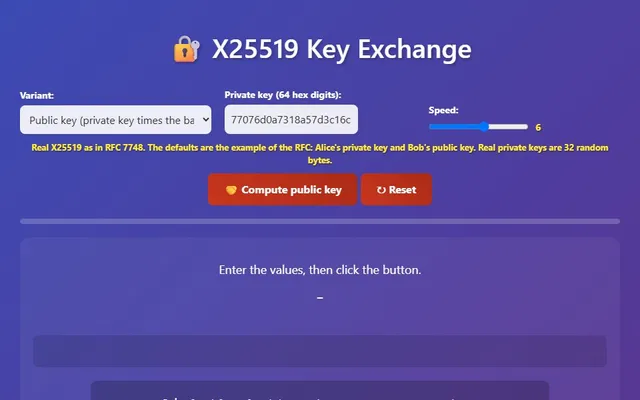
A visual representation of the X25519 key exchange
Modern Asymmetric Algorithms Advanced

X25519 and Curve25519

X25519 is the Diffie-Hellman function on Curve25519, defined in RFC 7748. Learn how a 32-byte private key is clamped, how the Montgomery ladder multiplies a point using only its u coordinate, why the curve was chosen, and what the all-zero check protects against.

18 min read

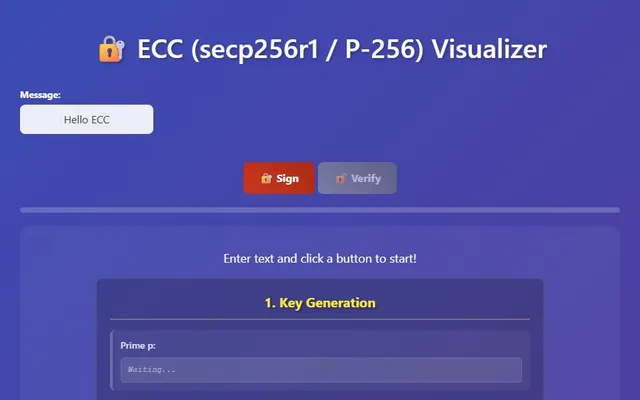
A visual representation of the ECC Protocol.
Modern Asymmetric Algorithms Advanced

Elliptic Curve Cryptography

ECC gets RSA-level security from far smaller keys. Here's the curve math behind it, and why it now powers most of the web.

13 min read

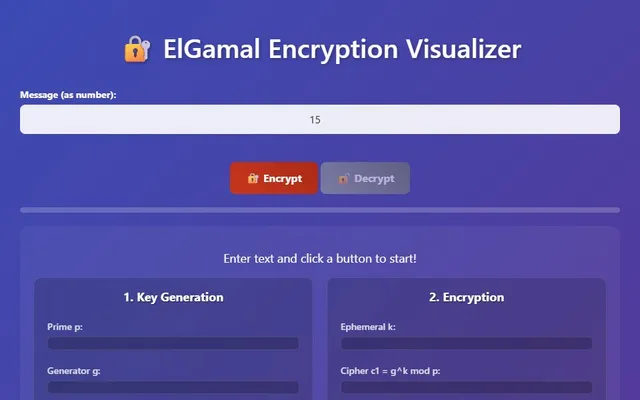
A visual representation of the ElGamal encryption scheme.
Modern Asymmetric Algorithms Advanced

ElGamal Encryption

ElGamal turns Diffie-Hellman key exchange into full public-key encryption. Here's how the discrete-log problem protects every message it sends.

7 min read

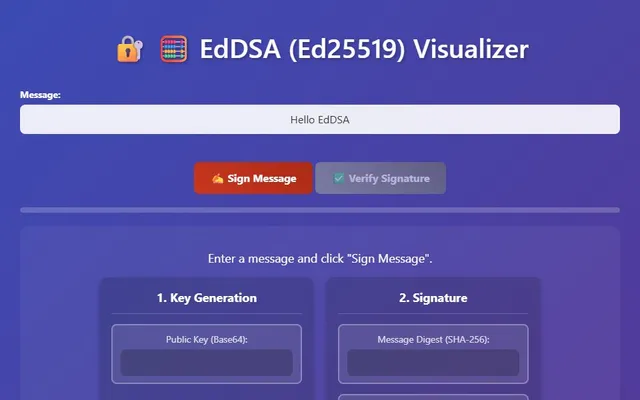
A visual representation of the EdDSA Protocol.
Modern Asymmetric Algorithms Advanced

EdDSA

EdDSA replaced random nonces with deterministic ones, closing off one of ECDSA's worst failure modes. Here's the math behind Ed25519.

8 min read

← All categories