Cipher Visualizers home

Category

Post-Quantum Cryptography

14 articles in this category.

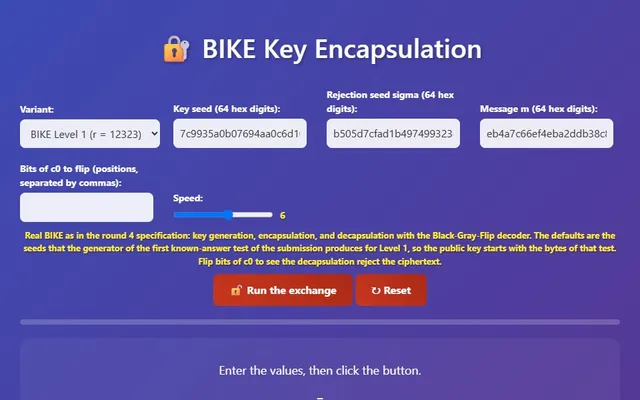
A visual representation of the BIKE key encapsulation scheme
Post-Quantum Cryptography Advanced

BIKE: Bit Flipping Key Encapsulation

BIKE is a post-quantum key encapsulation scheme built on codes with a sparse parity-check matrix. Learn how its keys hide a sparse code in a dense one, how the Black-Gray-Flip decoder removes the error, why one flipped bit is rejected, and why NIST chose HQC instead.

30 min read
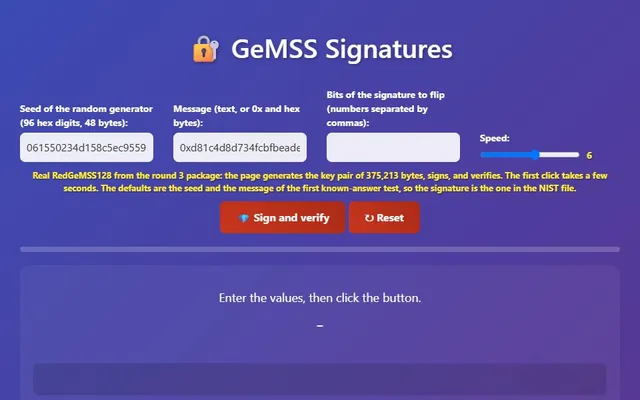
A visual representation of the GeMSS multivariate signature scheme
Post-Quantum Cryptography Advanced

GeMSS: Multivariate Signatures with HFEv-

GeMSS is a post-quantum signature scheme whose signatures have only a few hundred bits and whose public key is a system of quadratic equations. Learn how a hidden polynomial over GF(2^n) becomes a signature, how the signer finds roots, and why NIST dropped the scheme after a key-recovery attack.

41 min read

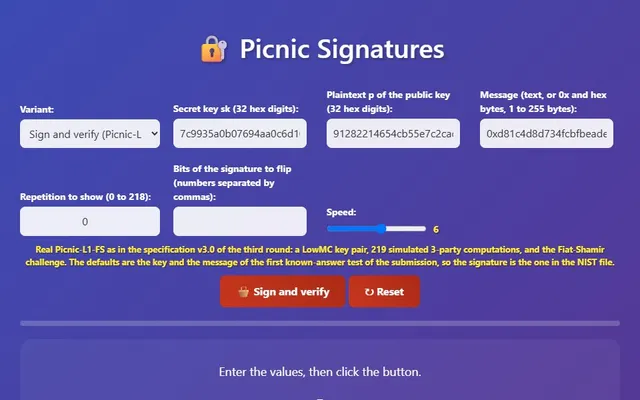
A visual representation of the Picnic signature scheme
Post-Quantum Cryptography Advanced

Picnic: Signatures from Symmetric Primitives and Zero Knowledge

Picnic is a post-quantum signature scheme built only from a block cipher and a hash function. Learn how a zero-knowledge proof about a secret LowMC key becomes a signature, how three simulated parties hide the key, why 219 repetitions are needed, and why NIST did not select it.

36 min read

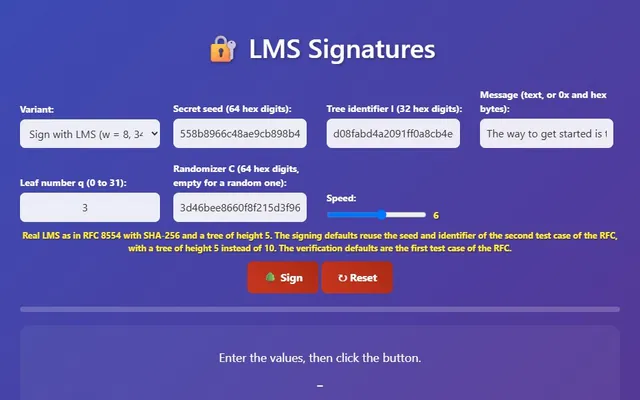
A visual representation of the LMS hash-based signature scheme
Post-Quantum Cryptography Advanced

XMSS and LMS Hash-Based Signatures

XMSS and LMS sign with nothing but a hash function, so quantum computers do not break them. Learn how Winternitz chains and Merkle trees work, why a signer must never reuse a one-time key, and how a reused key lets an attacker forge a message.

34 min read

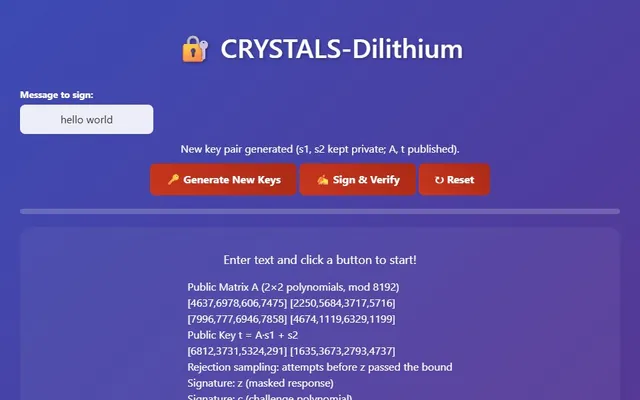
A visual representation of the CRYSTALS-Dilithium (ML-DSA) Algorithm
Post-Quantum Cryptography Advanced

CRYSTALS-Dilithium (ML-DSA)

NIST's primary post-quantum signature standard works by signing, checking your own signature against a size limit, and throwing it away and starting over if it's too big. Learn how 'Fiat-Shamir with Aborts' turns a leaky lattice proof into a secure signature.

14 min read

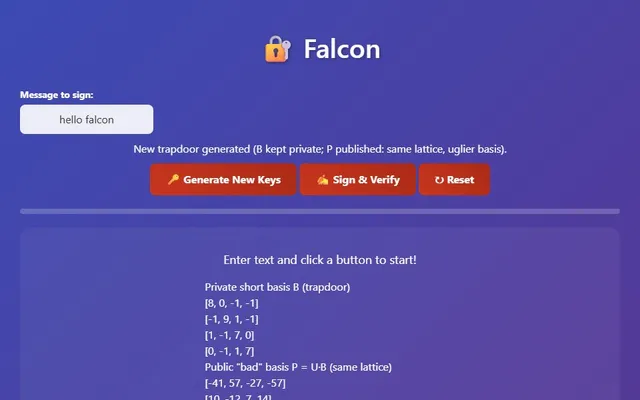
A visual representation of the Falcon Algorithm
Post-Quantum Cryptography Advanced

Falcon

Falcon produces the smallest signatures of any NIST post-quantum standard. It does that by solving a problem that broke the leading lattice signature schemes of the late 1990s/early 2000s. Learn the hash-and-sign paradigm, and why the naive version of it is fatally insecure.

13 min read

A visual representation of the FrodoKEM Algorithm
Post-Quantum Cryptography Advanced

FrodoKEM

FrodoKEM deliberately throws away the algebraic structure that makes lattice cryptography fast. It trades performance for a security proof that rests on plain, 'vanilla' Learning With Errors. Learn how it works and why some cryptographers prefer that trade.

10 min read

A visual representation of the HQC Algorithm
Post-Quantum Cryptography Advanced

HQC (Hamming Quasi-Cyclic)

In March 2025, NIST picked a second code-based algorithm to back up Kyber. This one hides its noise completely differently from McEliece. Learn how HQC masks a public, unscrambled code with pure algebraic randomness instead.

10 min read

A visual representation of the CRYSTALS-Kyber (ML-KEM) Algorithm
Post-Quantum Cryptography Advanced

CRYSTALS-Kyber (ML-KEM)

The key encapsulation mechanism NIST chose to replace RSA and ECDH for general-purpose use. Learn how Kyber hides a noisy linear system inside a polynomial ring to get both lattice-hard security and real-world speed.

9 min read

A visual representation of the NTRU Algorithm
Post-Quantum Cryptography Advanced

NTRU

Before Kyber, before LWE was even named, NTRU showed that ordinary polynomial multiplication in the right ring could resist quantum attacks. Learn how NTRU hides a fast decryption trick behind a public convolution product.

11 min read

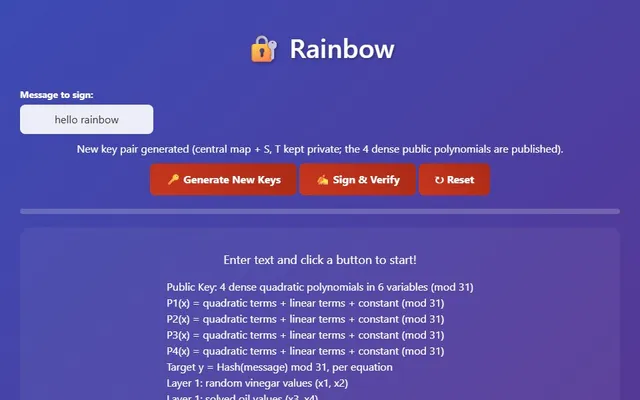
A visual representation of the RAINBOW Algorithm
Post-Quantum Cryptography Advanced

Rainbow

Rainbow signed messages using polynomial equations so tangled that solving them looks impossible. Then, in 2022, someone found a shortcut and broke it in a weekend on a laptop. Learn how it worked, and how it fell.

12 min read

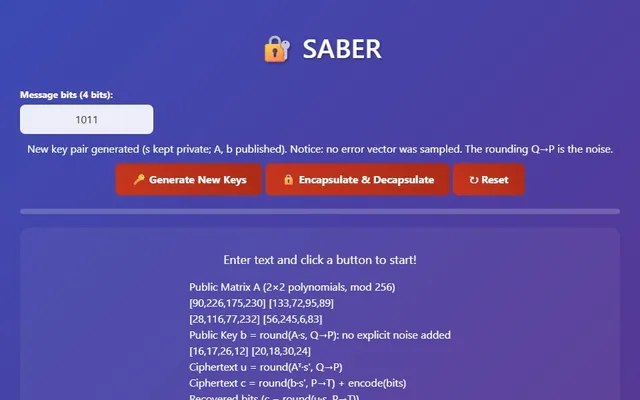
A visual representation of the SABER Algorithm
Post-Quantum Cryptography Advanced

SABER

SABER reached the final round of NIST's post-quantum competition with a trick Kyber doesn't use: instead of adding random noise, it rounds numbers down and lets the rounding error itself do the job. Learn how Learning With Rounding works.

10 min read

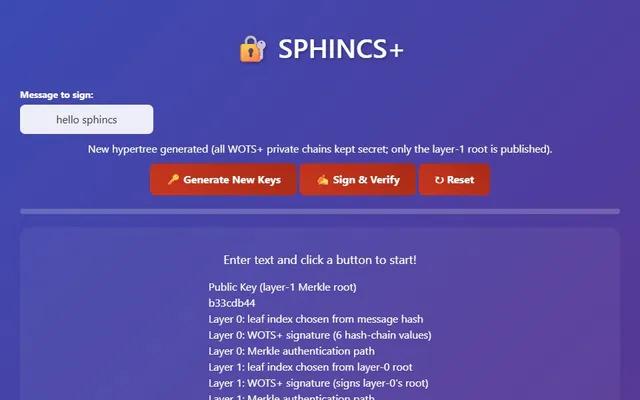
A visual representation of the SPHINCS+ Algorithm
Post-Quantum Cryptography Advanced

SPHINCS+

Every other post-quantum signature scheme bets on a new hard math problem holding up. SPHINCS+ makes almost no new bet at all: its security rests on nothing but hash functions. Learn how a tree of one-time signatures becomes a full signature scheme.

11 min read

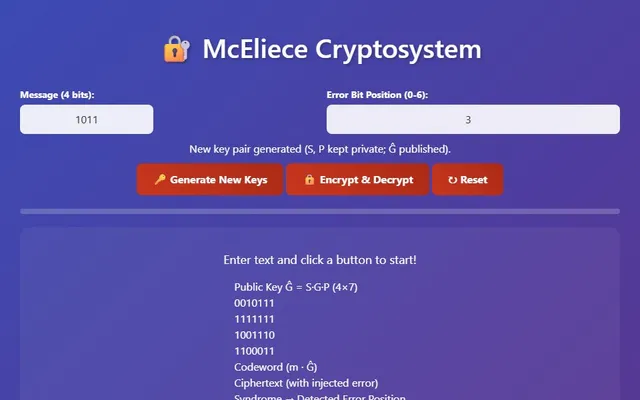
A visual representation of the McEliece Algorithm
Post-Quantum Cryptography Advanced

The McEliece Cryptosystem

McEliece has survived over 45 years of cryptanalysis without ever being broken. It's one of NIST's chosen post-quantum standards. Learn how hiding an error-correcting code behind scrambling matrices creates a public-key system quantum computers can't crack.

10 min read

← All categories