Cipher Visualizers home

Tag

#Digital Signatures

8 articles with this tag.

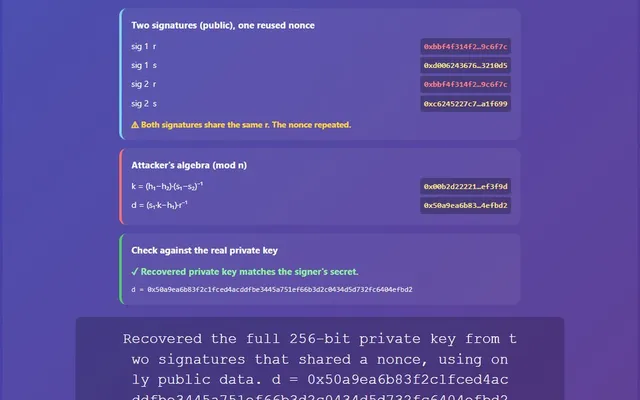
A visual representation of recovering an ECDSA private key from two signatures that reused the same nonce
Modern & Applied Cryptography Breakers Advanced

Recovering a DSA or ECDSA Key from a Reused Nonce

DSA and ECDSA stake everything on a secret random nonce that must never repeat. Sign two messages with the same nonce and the private key drops out with a little algebra. This guide runs the real attack against real DSA and secp256k1, the same flaw that broke the PS3 and drained Bitcoin wallets.

12 min read
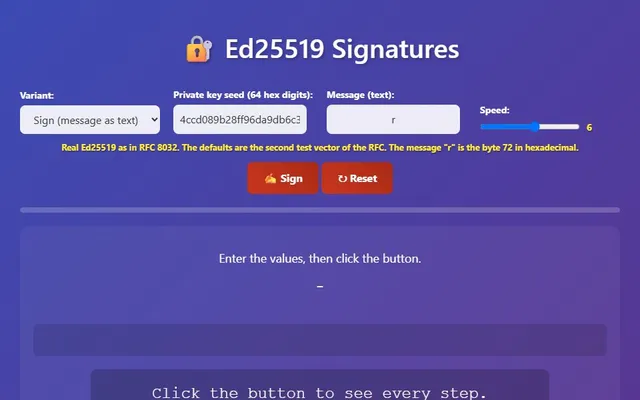
A visual representation of Ed25519 signatures
Modern Asymmetric Algorithms Advanced

Ed25519 Signatures

Ed25519 is the EdDSA signature scheme on the Edwards curve of Curve25519, defined in RFC 8032. Learn how a 32-byte seed becomes a key, how a deterministic nonce replaces random numbers, how a signature is checked with the cofactor, and why the range check on S matters.

19 min read

A visual representation of the GeMSS multivariate signature scheme
Post-Quantum Cryptography Advanced

GeMSS: Multivariate Signatures with HFEv-

GeMSS is a post-quantum signature scheme whose signatures have only a few hundred bits and whose public key is a system of quadratic equations. Learn how a hidden polynomial over GF(2^n) becomes a signature, how the signer finds roots, and why NIST dropped the scheme after a key-recovery attack.

41 min read

A visual representation of the Picnic signature scheme
Post-Quantum Cryptography Advanced

Picnic: Signatures from Symmetric Primitives and Zero Knowledge

Picnic is a post-quantum signature scheme built only from a block cipher and a hash function. Learn how a zero-knowledge proof about a secret LowMC key becomes a signature, how three simulated parties hide the key, why 219 repetitions are needed, and why NIST did not select it.

36 min read

A visual representation of the CRYSTALS-Dilithium (ML-DSA) Algorithm
Post-Quantum Cryptography Advanced

CRYSTALS-Dilithium (ML-DSA)

NIST's primary post-quantum signature standard works by signing, checking your own signature against a size limit, and throwing it away and starting over if it's too big. Learn how 'Fiat-Shamir with Aborts' turns a leaky lattice proof into a secure signature.

14 min read

A visual representation of the Falcon Algorithm
Post-Quantum Cryptography Advanced

Falcon

Falcon produces the smallest signatures of any NIST post-quantum standard. It does that by solving a problem that broke the leading lattice signature schemes of the late 1990s/early 2000s. Learn the hash-and-sign paradigm, and why the naive version of it is fatally insecure.

13 min read

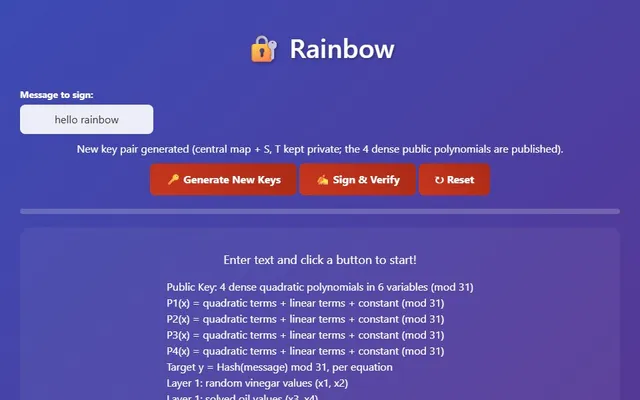
A visual representation of the RAINBOW Algorithm
Post-Quantum Cryptography Advanced

Rainbow

Rainbow signed messages using polynomial equations so tangled that solving them looks impossible. Then, in 2022, someone found a shortcut and broke it in a weekend on a laptop. Learn how it worked, and how it fell.

12 min read

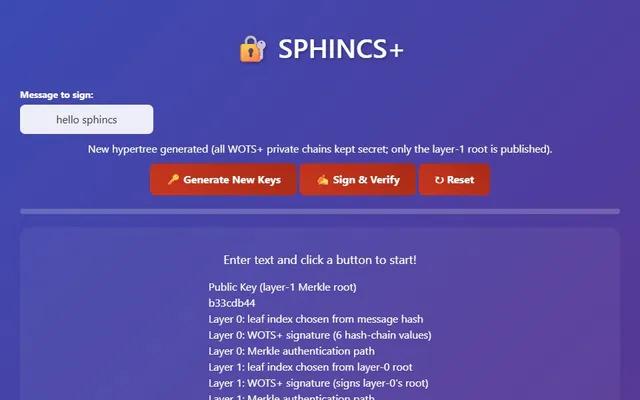
A visual representation of the SPHINCS+ Algorithm
Post-Quantum Cryptography Advanced

SPHINCS+

Every other post-quantum signature scheme bets on a new hard math problem holding up. SPHINCS+ makes almost no new bet at all: its security rests on nothing but hash functions. Learn how a tree of one-time signatures becomes a full signature scheme.

11 min read

← All tags