Cipher Visualizers home

Tag

#Digraph Cipher

5 articles with this tag.

A visual representation of the four-square cipher breaker recovering two key squares
Basic Classic Symmetric Breakers Advanced

Breaking the Four-Square Cipher with Two Key Squares

The four-square cipher hides letter frequencies behind two keyed grids, but it is still a pencil-and-paper cipher. Learn how simulated annealing with quadgram statistics recovers both secret squares from the ciphertext alone, with runnable Python.

14 min read
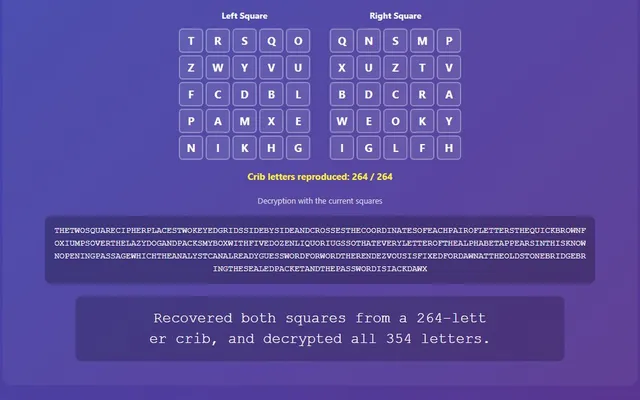
A visual representation of the two-square cipher breaker recovering two key squares from a crib
Basic Classic Symmetric Breakers Advanced

Breaking the Two-Square Cipher with a Crib

The two-square cipher resists the ciphertext-only search that breaks Playfair and four-square, because it has no fixed reference squares. But a crib of known plaintext breaks it in seconds. Learn the known-plaintext attack, with runnable Python.

13 min read

A visual representation of breaking the Playfair Cipher
Basic Classic Symmetric Breakers Advanced

Breaking the Playfair Cipher

Playfair defeated single-letter frequency analysis by encrypting pairs of letters through a 5×5 key square. But the same simulated-annealing idea that cracks the substitution cipher still works here too, once you swap in quadgram statistics and a richer set of moves.

20 min read

A visual representation of the Four-Square Cipher
Basic Classic Symmetric Intermediate

The Four-Square Cipher

Learn about the four-square cipher, a digraph substitution cipher that uses four 5x5 grids to encrypt letter pairs without Playfair's awkward same-row and same-column special cases.

12 min read

A visual representation of the Two-Square Cipher
Basic Classic Symmetric Intermediate

The Two-Square Cipher

Learn about the two-square cipher, a digraph substitution cipher that sits between Playfair's single grid and four-square's four grids: two independently keyed squares, one uniform encryption rule.

13 min read

← All tags