Cipher Visualizers home

Tag

#Hash Function

11 articles with this tag.

A visual representation of the RIPEMD-160 Algorithm
Hash Functions Intermediate

The RIPEMD-160 Algorithm

RIPEMD-160 is a 160-bit hash function that runs two independent lines of 80 steps over every block and then merges them. Learn how its padding, rounds, and combine step work, why Bitcoin still uses it, and how it compares with SHA-1.

20 min read

A visual representation of the Skein Algorithm
Hash Functions Advanced

The Skein Algorithm

Skein is a hash function built from the Threefish block cipher and a tweak that marks every block. It was one of the five finalists of the NIST SHA-3 competition. Learn how Unique Block Iteration, the configuration block, and the output stage work, with every digest checked.

18 min read

A visual representation of the SM3 Algorithm
Hash Functions Intermediate

The SM3 Algorithm

SM3 is the Chinese national standard hash function. It looks like SHA-256 at first glance, but its message expansion, step function, and 16 rounds of pure XOR are different. Learn how it works step by step, with every intermediate value checked against the standard.

15 min read

A visual representation of the Streebog Algorithm
Hash Functions Advanced

The Streebog Algorithm

Streebog, or GOST R 34.11-2012, is the Russian hash function standard. It hashes with a 12-round AES-like cipher, a length counter, and a checksum. Learn how its S-box, byte transposition, and linear map work, with every round of the RFC 6986 example checked.

19 min read

A visual representation of the Tiger Algorithm
Hash Functions Advanced

The Tiger Algorithm

Tiger is a 192-bit hash function designed for fast hashing on 64-bit processors. It uses four large S-boxes and only a handful of operations per round. Learn how its three passes, key schedule, and S-box generator work, and how Tiger2 differs.

16 min read

A visual representation of the Whirlpool Algorithm
Hash Functions Advanced

The Whirlpool Algorithm

Whirlpool is a 512-bit hash function built from an AES-like block cipher that works on an 8 by 8 matrix of bytes. Learn how its S-box, column shift, and diffusion matrix work, how the Miyaguchi-Preneel mode turns the cipher into a hash, and how it compares with SHA-2.

16 min read

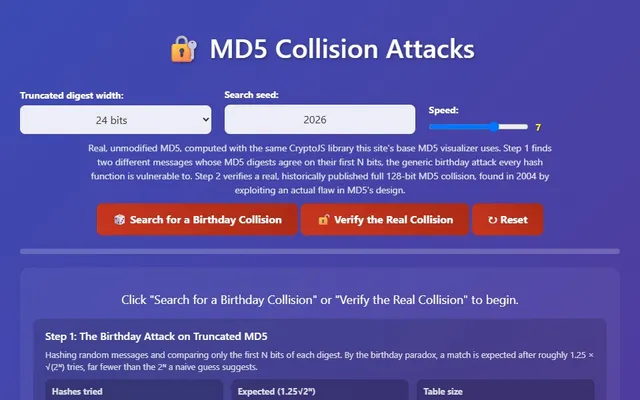
A visual representation of an MD5 hash collision
Modern & Applied Cryptography Breakers Intermediate

Breaking MD5 with Collision Attacks

Every hash function is vulnerable to a generic birthday attack. MD5 is vulnerable to something worse: a real, structural flaw that produces full 128-bit collisions far faster than any generic attack should allow. Both are demonstrated here, live and verified.

16 min read

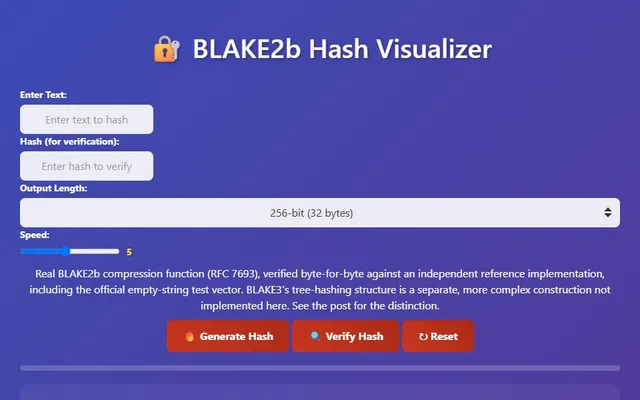
A visual representation of the BLAKE3 hashing algorithm.
Hash Functions Beginner

The Blake 2 and 3 Hash Algorithms

BLAKE2 and BLAKE3 have emerged as the preferred choice for new applications requiring high-performance hashing

20 min read

A visual representation of the SHA-1 hashing algorithm.
Hash Functions Beginner

Understanding the SHA-1 Algorithm

Secure Hash Algorithm 1 was for years one of the most widely used cryptographic hash functions.

9 min read

A visual representation of the MD-5 hashing algorithm.
Hash Functions Beginner

MD5

Ronald Rivest designed MD5 in 1991. By 2004 it was broken. Here's the algorithm, and why real collisions ended its cryptographic career.

9 min read

← All tags