Cipher Visualizers home

Tag

#Key Exchange

8 articles with this tag.

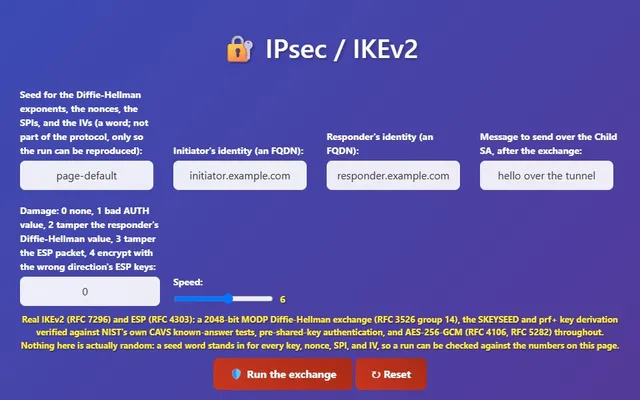
A visual representation of the IPsec and IKEv2 protocols
Hybrid Functions Advanced

IPsec and IKEv2

IPsec protects IP traffic with ESP, and IKEv2 negotiates the keys. Learn the SKEYSEED key derivation, pre-shared-key authentication, and AES-GCM, with Python code checked against 280 of NIST's own known-answer test vectors.

26 min read
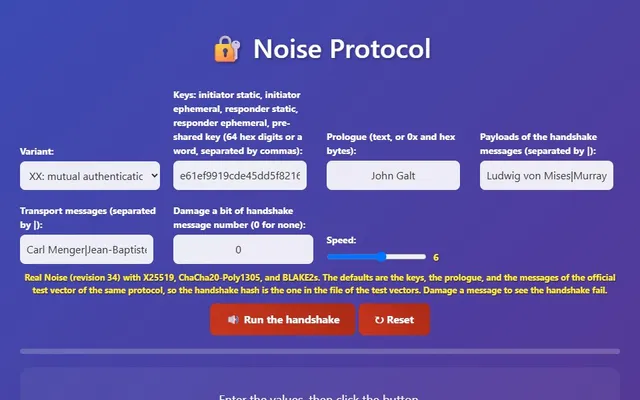
A visual representation of the Noise Protocol Framework
Hybrid Functions Advanced

The Noise Protocol Framework

Noise is a framework for building secure channels from Diffie-Hellman exchanges. A protocol is a short pattern of tokens and a name. Learn the three state objects, the 38 handshake patterns, pre-shared keys, and the security properties, with a Python engine that reproduces 1,352 official test vectors.

34 min read

A visual representation of the OPAQUE password-authenticated key exchange
Hybrid Functions Advanced

OPAQUE

OPAQUE is a password-authenticated key exchange that gives a server nothing to steal: not the password, not a dictionary-attackable verifier. Learn the oblivious pseudorandom function at its core, the envelope that hides a client's key pair, and the 3DH handshake, with Python code that reproduces the official RFC 9807 test vectors.

30 min read

A visual representation of the Secure Remote Password protocol
Hybrid Functions Advanced

SRP: Logging In with a Password Without Sending It

SRP is a password-authenticated key exchange. The server stores only a verifier, the password never crosses the network, and an eavesdropper cannot test guesses. Learn the SRP-6 mathematics of RFC 5054, the proofs of RFC 2945, and the checks that decide its security.

22 min read

A visual representation of the SSH protocol handshake
Hybrid Functions Advanced

The SSH Protocol

SSH secures remote logins with a binary packet protocol, a curve25519-sha256 key exchange, and an Ed25519 host key. Learn the handshake and the chacha20-poly1305@openssh.com cipher, with Python code that reproduces the IETF draft's own worked example byte for byte.

29 min read

A visual representation of the ECDH key exchange
Modern Asymmetric Algorithms Advanced

Elliptic Curve Diffie-Hellman (ECDH)

ECDH lets two parties agree on a shared secret using points on an elliptic curve. Learn how P-256, P-384, and secp256k1 define the group, how public keys are encoded and validated, why the secret is only an x coordinate, and how an invalid-curve attack works.

23 min read

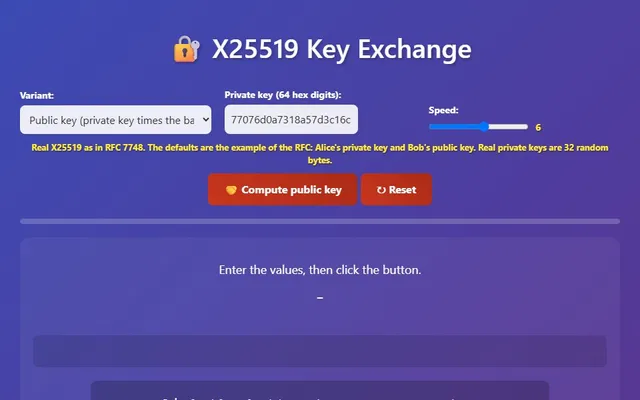
A visual representation of the X25519 key exchange
Modern Asymmetric Algorithms Advanced

X25519 and Curve25519

X25519 is the Diffie-Hellman function on Curve25519, defined in RFC 7748. Learn how a 32-byte private key is clamped, how the Montgomery ladder multiplies a point using only its u coordinate, why the curve was chosen, and what the all-zero check protects against.

18 min read

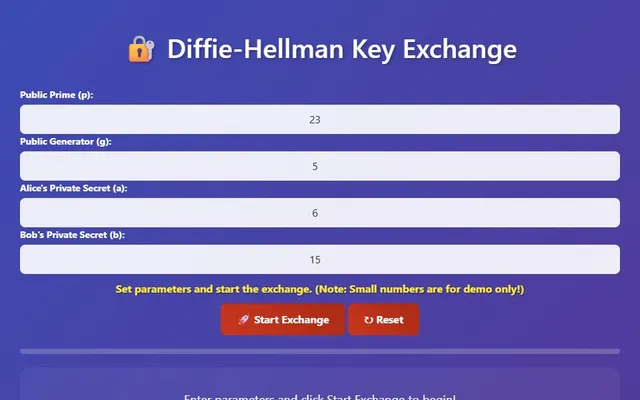
A visual representation of the Diffie-Hellman Key Exchange
Classic Asymmetric Algorithms Intermediate

Diffie-Hellman Key Exchange

Diffie-Hellman solved cryptography's oldest problem: sharing a secret over a channel anyone can watch. Here's the math, and how it still secures the web.

14 min read

← All tags