Cipher Visualizers home

Tag

#Known-Plaintext Attack

5 articles with this tag.

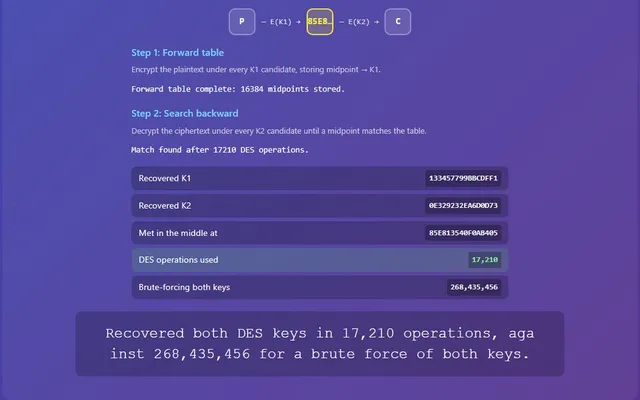
A visual representation of the meet-in-the-middle attack recovering two DES keys
Modern & Applied Cryptography Breakers Intermediate

Breaking Double DES with Meet-in-the-Middle

Encrypting with DES twice looks like it should double the key to 112 bits. A meet-in-the-middle attack shows it barely adds one bit of real security, which is why 3DES uses three passes. Learn the attack with runnable Python against real DES.

12 min read
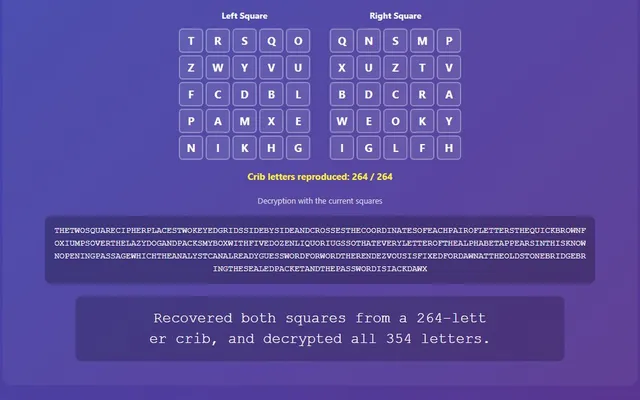
A visual representation of the two-square cipher breaker recovering two key squares from a crib
Basic Classic Symmetric Breakers Advanced

Breaking the Two-Square Cipher with a Crib

The two-square cipher resists the ciphertext-only search that breaks Playfair and four-square, because it has no fixed reference squares. But a crib of known plaintext breaks it in seconds. Learn the known-plaintext attack, with runnable Python.

13 min read

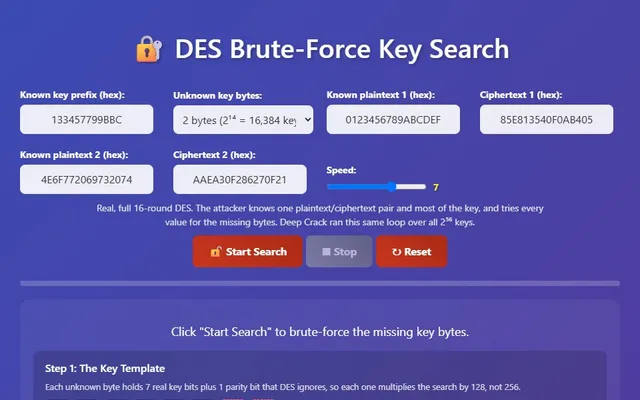
A visual representation of breaking DES by exhaustive key search
Modern & Applied Cryptography Breakers Intermediate

Breaking DES with Brute-Force Key Search

DES never fell to clever math. It fell to a loop: try a key, encrypt a known block, compare, repeat. This post runs that exact loop against real DES, the same one EFF's Deep Crack ran over all 2⁵⁶ keys in 1998.

18 min read

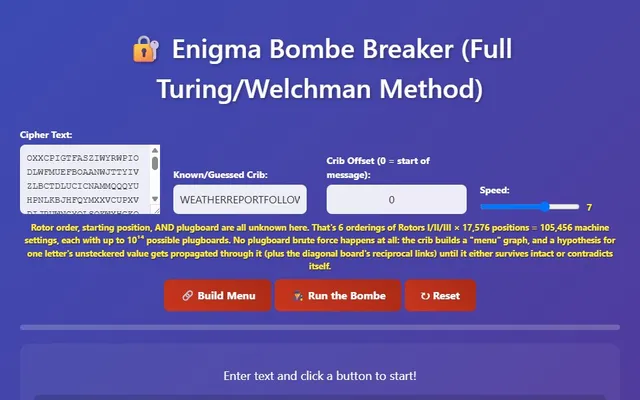
A visual representation of the Turing/Welchman Bombe breaking Enigma
Basic Classic Symmetric Breakers Advanced

Breaking Enigma the Real Way: The Turing/Welchman Bombe

The site's simplified Enigma breaker fixes the rotor order, skips the plugboard, and brute-forces 17,576 positions by statistics. The real Bombe did none of that. It searched rotor order and position too, deduced the plugboard through pure logic, and never scored a single decryption.

34 min read

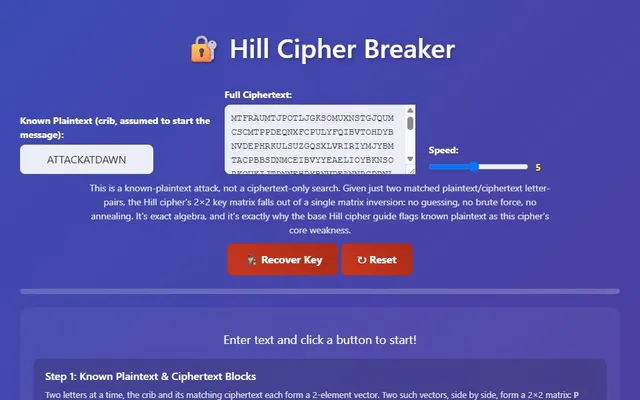
A visual representation of breaking the Hill Cipher
Basic Classic Symmetric Breakers Intermediate

Breaking the Hill Cipher

Every other breaker on this site attacks ciphertext alone, guessing at a key through brute force or statistical search. The Hill cipher doesn't need any of that. Its encryption is pure linear algebra, so a handful of known plaintext letters is enough to solve for the entire key matrix directly.

16 min read

← All tags