Cipher Visualizers home

Tag

#Number Theory

7 articles with this tag.

A visual representation of breaking Diffie-Hellman via baby-step giant-step
Modern & Applied Cryptography Breakers Intermediate

Breaking Diffie-Hellman with Baby-Step Giant-Step

Diffie-Hellman's security rests on the discrete logarithm problem being hard. For a small prime, it isn't. Baby-step giant-step trades a brute-force search of size p for one of roughly √p, and that's the whole reason real DH needs huge safe primes.

11 min read

A visual representation of breaking ElGamal via the discrete logarithm
Modern & Applied Cryptography Breakers Intermediate

Breaking ElGamal with Baby-Step Giant-Step

ElGamal's private key is just another discrete logarithm. The same baby-step giant-step technique that breaks Diffie-Hellman over a small prime recovers ElGamal's private key too, and from there decrypts any captured ciphertext directly.

11 min read

A visual representation of breaking RSA via Håstad's broadcast attack
Modern & Applied Cryptography Breakers Intermediate

Breaking RSA with Håstad's Broadcast Attack

A low public exponent like e=3 is efficient and, by itself, still safe. Broadcast the same message to three recipients using e=3 with no padding, and the Chinese Remainder Theorem recovers it with no private key at all.

10 min read

A visual representation of breaking RSA via the common modulus attack
Modern & Applied Cryptography Breakers Intermediate

Breaking RSA with the Common Modulus Attack

Sharing one RSA modulus across multiple key pairs looks like a harmless shortcut: skip prime generation, reuse n. If the same message ever gets encrypted under two of those keys, no private key is needed to read it back.

13 min read

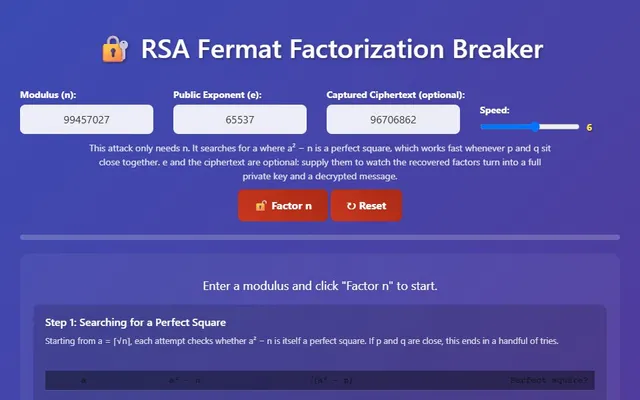
A visual representation of breaking RSA via Fermat factorization
Modern & Applied Cryptography Breakers Intermediate

Breaking RSA with Fermat Factorization

RSA's security assumes factoring n back into p and q is infeasible. That assumption quietly breaks if the key generator picks p and q too close together. Fermat's 1643 factoring method recovers them both in seconds.

13 min read

A visual representation of breaking RSA via Wiener's attack
Modern & Applied Cryptography Breakers Advanced

Breaking RSA with Wiener's Attack

Small private exponents make RSA decryption and signing faster. Michael Wiener showed in 1990 that a d small enough to help performance is also small enough to recover from the public key alone, via continued fractions.

12 min read

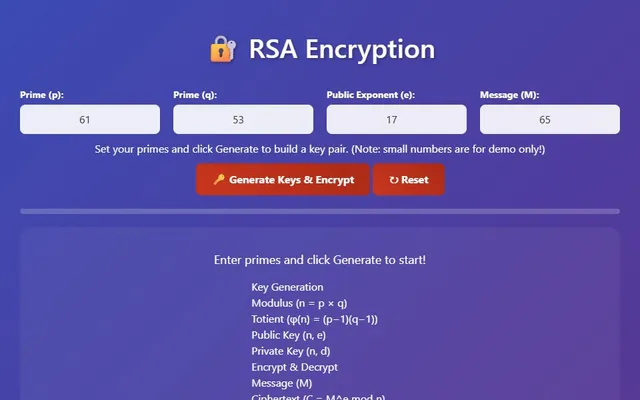
A visual representation of the RSA Algorithm
Classic Asymmetric Algorithms Intermediate

RSA

RSA made public-key cryptography practical for the world. Here's how it works, why it's secure, and where it's headed as quantum computing looms.

18 min read

← All tags