Cipher Visualizers home

Tag

#Simulated Annealing

5 articles with this tag.

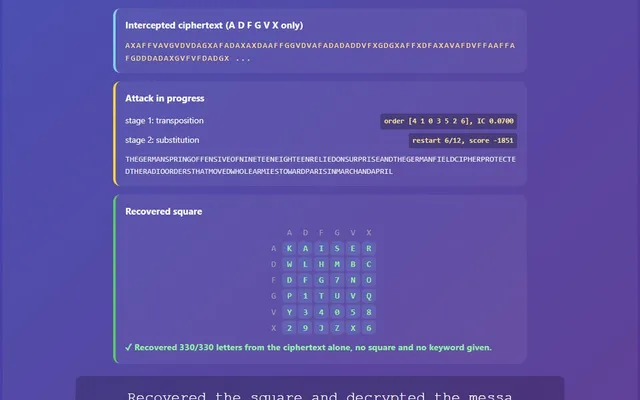
A visual representation of recovering the ADFGVX transposition and substitution to decrypt a message
Basic Classic Symmetric Breakers Advanced

Breaking the ADFGVX Cipher

ADFGVX fractionates each letter into two symbols and then shuffles them with a columnar transposition, the combination that made it Germany's toughest field cipher of 1918. This guide runs the modern automated attack: recover the transposition with the index of coincidence, then solve the substitution with quadgrams, and read a 330-letter message back out.

14 min read
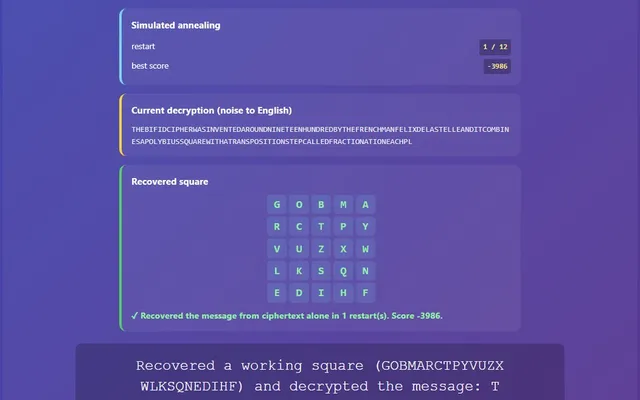
A visual representation of simulated annealing recovering a Bifid Polybius square from ciphertext
Basic Classic Symmetric Breakers Advanced

Breaking the Bifid Cipher with Simulated Annealing

Bifid fractionates each letter into coordinates and shuffles them, which hides single-letter frequencies. Given the period, a hill climb over the Polybius square guided by English quadgram statistics peels the key apart anyway. This guide runs the real attack and recovers a 669-letter message.

13 min read

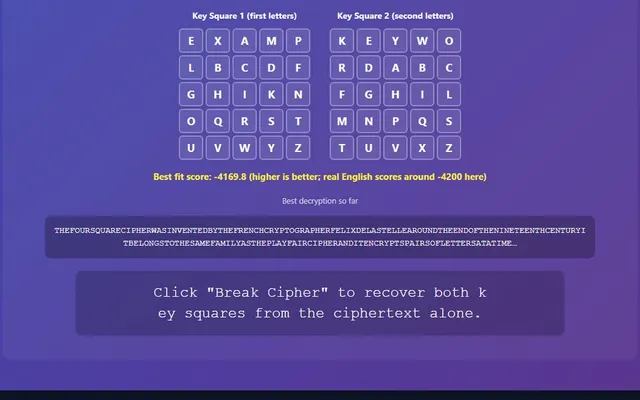
A visual representation of the four-square cipher breaker recovering two key squares
Basic Classic Symmetric Breakers Advanced

Breaking the Four-Square Cipher with Two Key Squares

The four-square cipher hides letter frequencies behind two keyed grids, but it is still a pencil-and-paper cipher. Learn how simulated annealing with quadgram statistics recovers both secret squares from the ciphertext alone, with runnable Python.

14 min read

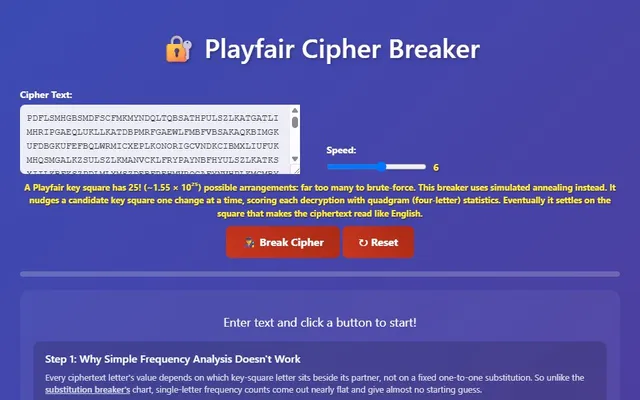
A visual representation of breaking the Playfair Cipher
Basic Classic Symmetric Breakers Advanced

Breaking the Playfair Cipher

Playfair defeated single-letter frequency analysis by encrypting pairs of letters through a 5×5 key square. But the same simulated-annealing idea that cracks the substitution cipher still works here too, once you swap in quadgram statistics and a richer set of moves.

20 min read

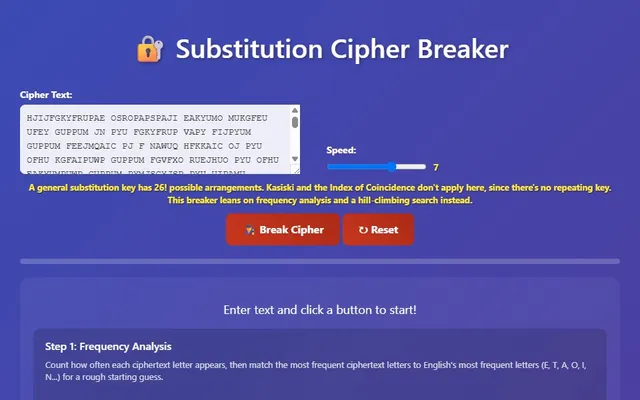
A visual representation of breaking the monoalphabetic Substitution Cipher
Basic Classic Symmetric Breakers Advanced

Breaking the Substitution Cipher

A monoalphabetic substitution key is one arbitrary permutation of 26 letters: 26! of them, far too many to brute force and immune to Kasiski or the Index of Coincidence since there's no repeating key. Here's how frequency analysis and a hill-climbing search crack it anyway.

26 min read

← All tags