Tag Archive

#Key Encapsulation

Found 4 articles with this tag.

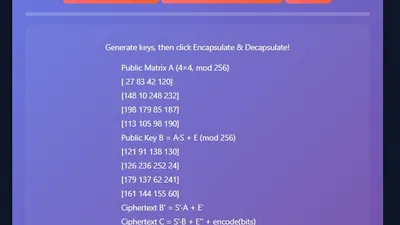
FrodoKEM

FrodoKEM deliberately throws away the algebraic structure that makes lattice cryptography fast — trading performance for a security proof that rests on plain, 'vanilla' Learning With Errors. Learn how it works and why some cryptographers prefer that trade.
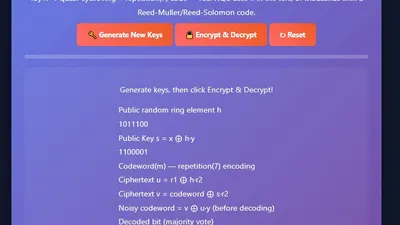
HQC (Hamming Quasi-Cyclic)

In March 2025, NIST picked a second code-based algorithm to back up Kyber — one that hides its noise completely differently from McEliece. Learn how HQC masks a public, unscrambled code with pure algebraic randomness instead.

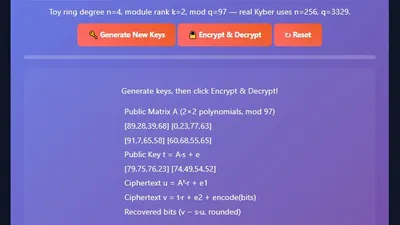
CRYSTALS-Kyber (ML-KEM)

The key encapsulation mechanism NIST chose to replace RSA and ECDH for general-purpose use. Learn how Kyber hides a noisy linear system inside a polynomial ring to get both lattice-hard security and real-world speed.

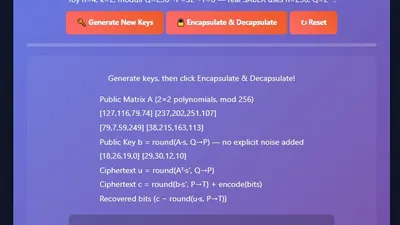
SABER

SABER reached the final round of NIST's post-quantum competition with a trick Kyber doesn't use: instead of adding random noise, it rounds numbers down and lets the rounding error itself do the job. Learn how Learning With Rounding works.