Tag Archive

#Lattice-Based Cryptography

Found 6 articles with this tag.

CRYSTALS-Dilithium (ML-DSA)

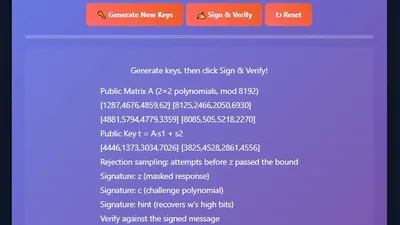
NIST's primary post-quantum signature standard works by signing, checking your own signature against a size limit, and throwing it away and starting over if it's too big. Learn how 'Fiat-Shamir with Aborts' turns a leaky lattice proof into a secure signature.
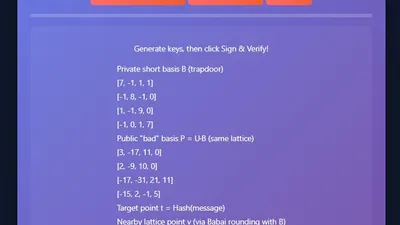
Falcon

Falcon produces the smallest signatures of any NIST post-quantum standard — by solving a problem that broke the leading lattice signature schemes of the late 1990s/early 2000s. Learn the hash-and-sign paradigm, and why the naive version of it is fatally insecure.

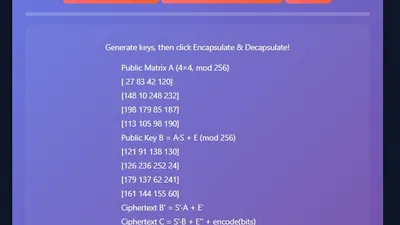
FrodoKEM

FrodoKEM deliberately throws away the algebraic structure that makes lattice cryptography fast — trading performance for a security proof that rests on plain, 'vanilla' Learning With Errors. Learn how it works and why some cryptographers prefer that trade.

CRYSTALS-Kyber (ML-KEM)

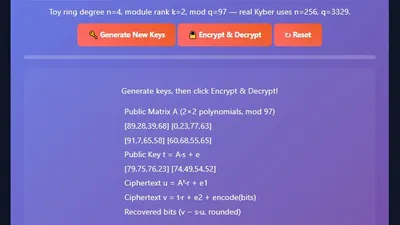
The key encapsulation mechanism NIST chose to replace RSA and ECDH for general-purpose use. Learn how Kyber hides a noisy linear system inside a polynomial ring to get both lattice-hard security and real-world speed.

NTRU

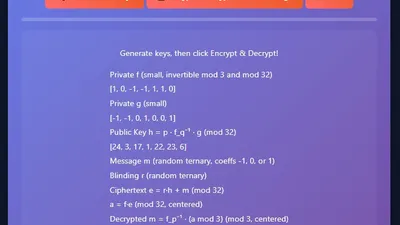
Before Kyber, before LWE was even named, NTRU showed that ordinary polynomial multiplication in the right ring could resist quantum attacks. Learn how NTRU hides a fast decryption trick behind a public convolution product.

SABER

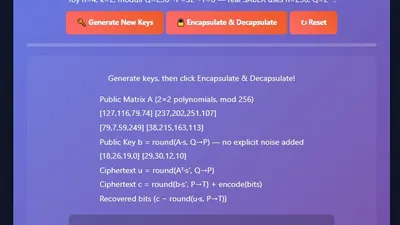
SABER reached the final round of NIST's post-quantum competition with a trick Kyber doesn't use: instead of adding random noise, it rounds numbers down and lets the rounding error itself do the job. Learn how Learning With Rounding works.