Tag Archive

#Post-Quantum Cryptography

Found 10 articles with this tag.

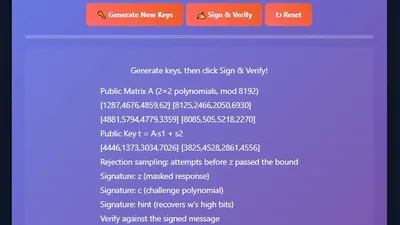
CRYSTALS-Dilithium (ML-DSA)

NIST's primary post-quantum signature standard works by signing, checking your own signature against a size limit, and throwing it away and starting over if it's too big. Learn how 'Fiat-Shamir with Aborts' turns a leaky lattice proof into a secure signature.
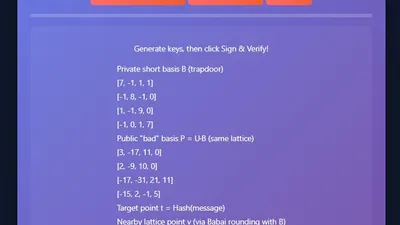
Falcon

Falcon produces the smallest signatures of any NIST post-quantum standard — by solving a problem that broke the leading lattice signature schemes of the late 1990s/early 2000s. Learn the hash-and-sign paradigm, and why the naive version of it is fatally insecure.

FrodoKEM

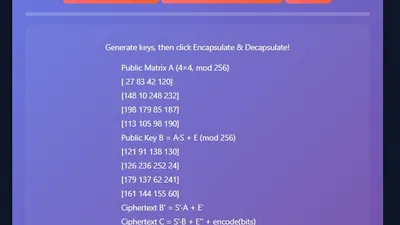
FrodoKEM deliberately throws away the algebraic structure that makes lattice cryptography fast — trading performance for a security proof that rests on plain, 'vanilla' Learning With Errors. Learn how it works and why some cryptographers prefer that trade.

HQC (Hamming Quasi-Cyclic)

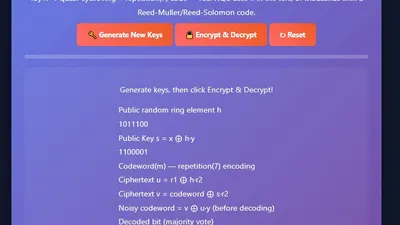
In March 2025, NIST picked a second code-based algorithm to back up Kyber — one that hides its noise completely differently from McEliece. Learn how HQC masks a public, unscrambled code with pure algebraic randomness instead.

CRYSTALS-Kyber (ML-KEM)

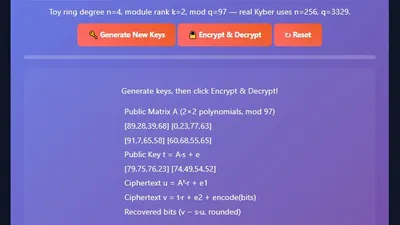
The key encapsulation mechanism NIST chose to replace RSA and ECDH for general-purpose use. Learn how Kyber hides a noisy linear system inside a polynomial ring to get both lattice-hard security and real-world speed.

The McEliece Cryptosystem

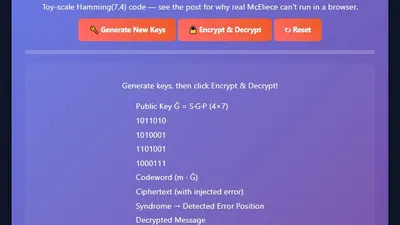
McEliece has survived over 45 years of cryptanalysis without ever being broken — and it's one of NIST's chosen post-quantum standards. Learn how hiding an error-correcting code behind scrambling matrices creates a public-key system quantum computers can't crack.

NTRU

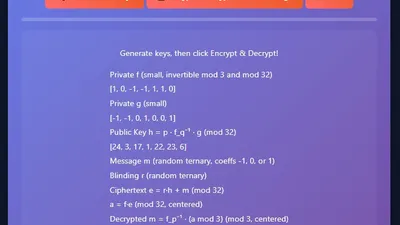
Before Kyber, before LWE was even named, NTRU showed that ordinary polynomial multiplication in the right ring could resist quantum attacks. Learn how NTRU hides a fast decryption trick behind a public convolution product.

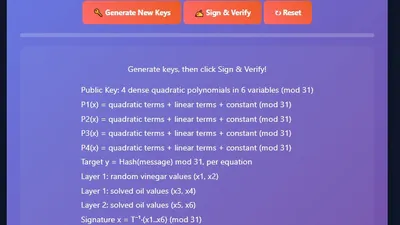
Rainbow

Rainbow signed messages using polynomial equations so tangled that solving them looks impossible — until, in 2022, someone found a shortcut and broke it in a weekend on a laptop. Learn how it worked, and how it fell.

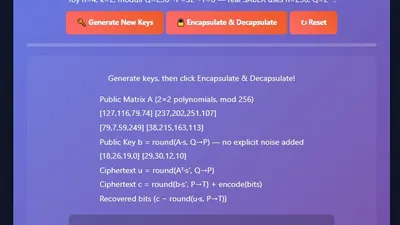
SABER

SABER reached the final round of NIST's post-quantum competition with a trick Kyber doesn't use: instead of adding random noise, it rounds numbers down and lets the rounding error itself do the job. Learn how Learning With Rounding works.

SPHINCS+

Every other post-quantum signature scheme bets on a new hard math problem holding up. SPHINCS+ makes almost no new bet at all — its security rests on nothing but hash functions. Learn how a tree of one-time signatures becomes a full signature scheme.