Breaking the Affine Cipher
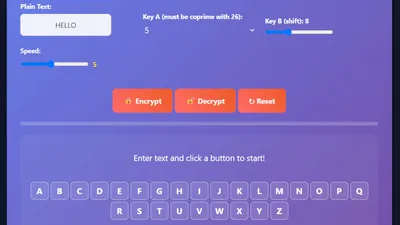
Learn how to break the Affine cipher by brute-forcing its entire 312-key keyspace and scoring each decryption with a common-word heuristic. It's the same strategy that cracks Caesar, just applied to a slightly bigger lock.
CATEGORY
Showing 12 post(s) in this category.
Learn how to break the Affine cipher by brute-forcing its entire 312-key keyspace and scoring each decryption with a common-word heuristic. It's the same strategy that cracks Caesar, just applied to a slightly bigger lock.
The Autokey cipher defeats Kasiski examination and the Index of Coincidence by never repeating its key. But the short priming key that starts everything off is still just a handful of letters, and one wrong guess collapses the entire decryption for you.
The Beaufort cipher's reciprocal formula (C = K − P instead of Vigenère's C = P + K) looks like it should matter to an attacker. It doesn't: the same Kasiski examination, Index of Coincidence, and chi-squared pipeline that breaks Vigenère breaks Beaufort just as cleanly.
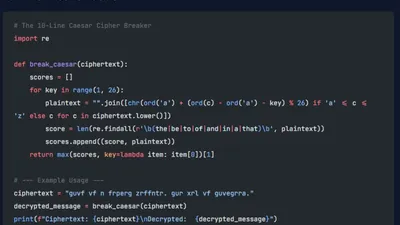
Breaking the Caesar Cipher: A Python Journey from Comprehensive to Concise
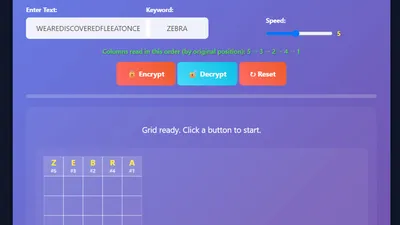
Columnar transposition doesn't hide letters. It just rearranges them, so frequency analysis finds nothing wrong. Learn the attack that actually works: brute-forcing every column order for each candidate key length, scored by common English substrings.
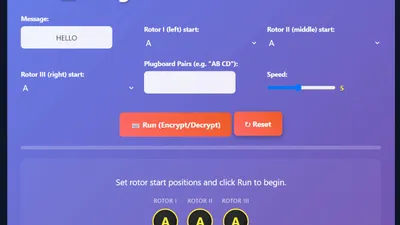
The site's simplified Enigma breaker fixes the rotor order, skips the plugboard, and brute-forces 17,576 positions by statistics. The real Bombe did none of that. It searched rotor order and position too, deduced the plugboard through pure logic, and never scored a single decryption.
The real wartime Enigma resisted brute force because of two unknowns stacked on top of its rotor positions: which three rotors were chosen and in what order, and how the plugboard was wired. Together these push the key space past 10^20. Strip those two unknowns away and only 17,576 rotor positions are left, small enough for a modern computer to brute-force outright.
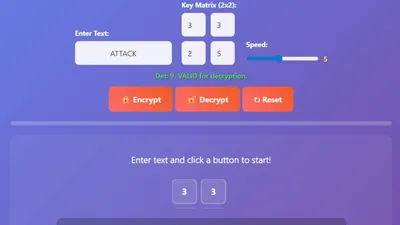
Every other breaker on this site attacks ciphertext alone, guessing at a key through brute force or statistical search. The Hill cipher doesn't need any of that. Its encryption is pure linear algebra, so a handful of known plaintext letters is enough to solve for the entire key matrix directly.
Playfair defeated single-letter frequency analysis by encrypting pairs of letters through a 5×5 key square. But the same simulated-annealing idea that cracks the substitution cipher still works here too, once you swap in quadgram statistics and a richer set of moves.
Every other transposition breaker on this site has to search over orderings. Columnar Transposition alone hides a factorial number of column arrangements behind its key. Rail Fence has no such trapdoor: the entire key is a single small number, so brute force checks every possibility outright.
A monoalphabetic substitution key is one arbitrary permutation of 26 letters: 26! of them, far too many to brute force and immune to Kasiski or the Index of Coincidence since there's no repeating key. Here's how frequency analysis and a hill-climbing search crack it anyway.
For three centuries the Vigenère cipher was called 'le chiffre indéchiffrable.' Learn the two statistical techniques, Kasiski examination and the Index of Coincidence, that finally broke it, and watch them recover a real key letter by letter.