
Classic Asymmetric Algorithms Intermediate
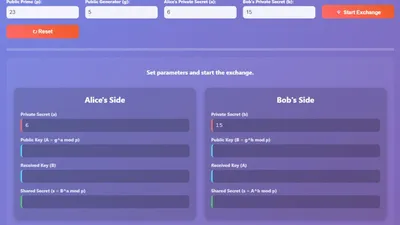
Diffie-Hellman Key Exchange
Diffie-Hellman solved cryptography's oldest problem: sharing a secret over a channel anyone can watch. Here's the math, and how it still secures the web.
Tag Archive
Found 10 articles with this tag.
Diffie-Hellman solved cryptography's oldest problem: sharing a secret over a channel anyone can watch. Here's the math, and how it still secures the web.
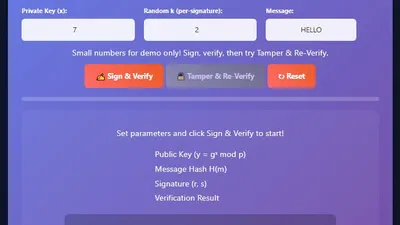
DSA was the U.S. government's answer to a simple question: how do you prove a message came from you, without RSA's patent? Learn how the Digital Signature Algorithm works, and why a single reused number sank Sony's PS3 security.

ECC gets RSA-level security from far smaller keys. Here's the curve math behind it, and why it now powers most of the web.
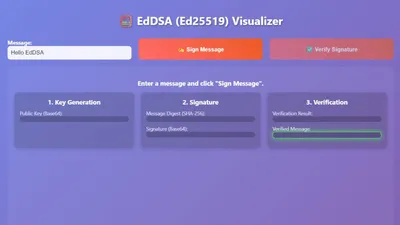
EdDSA replaced random nonces with deterministic ones, closing off one of ECDSA's worst failure modes. Here's the math behind Ed25519.
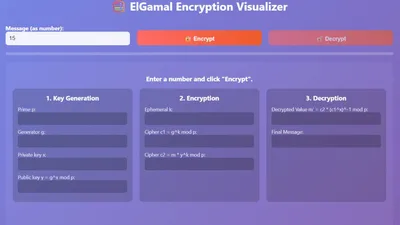
ElGamal turns Diffie-Hellman key exchange into full public-key encryption. Here's how the discrete-log problem protects every message it sends.
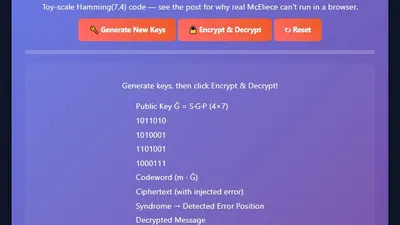
McEliece has survived over 45 years of cryptanalysis without ever being broken. It's one of NIST's chosen post-quantum standards. Learn how hiding an error-correcting code behind scrambling matrices creates a public-key system quantum computers can't crack.
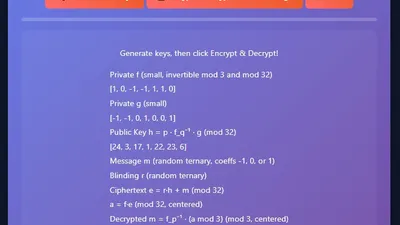
Before Kyber, before LWE was even named, NTRU showed that ordinary polynomial multiplication in the right ring could resist quantum attacks. Learn how NTRU hides a fast decryption trick behind a public convolution product.
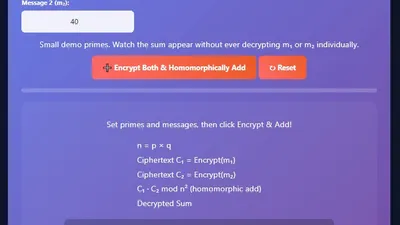
What if you could add two numbers together without ever decrypting them? Paillier encryption makes that possible. It's the mathematical trick behind private vote tallying and secure multi-party computation.
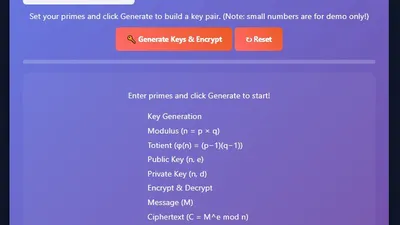
RSA made public-key cryptography practical for the world. Here's how it works, why it's secure, and where it's headed as quantum computing looms.
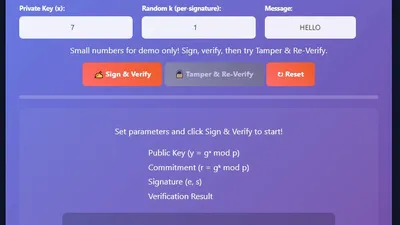
Schnorr signatures are what DSA might have been if a 20-year patent hadn't gotten in the way. Simpler, provably secure, and now at the heart of Bitcoin's Taproot upgrade: here's how they work.