Tag Archive

#Classic Cipher

Found 26 articles with this tag.

The ADFGVX Cipher

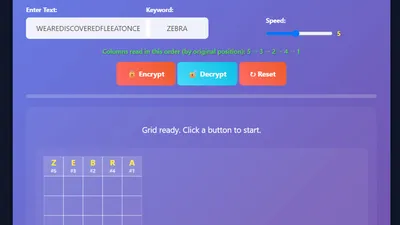
Learn about ADFGVX, the German WWI field cipher that combined Polybius-square fractionation with columnar transposition. It was considered so strong that French cryptanalyst Georges Painvin needed weeks to break a message that helped stop a 1918 offensive.


The Affine Cipher

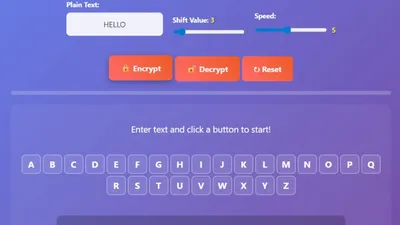
Learn about the Affine cipher, a generalization of the Caesar cipher that combines multiplication and addition to create a larger, but still breakable, keyspace.

The Autokey Cipher

Learn about the Autokey cipher, the Vigenère variant that fixes the repeating-key weakness by folding the plaintext itself into the key stream. That closes the door on Kasiski examination.

Bacon's Cipher

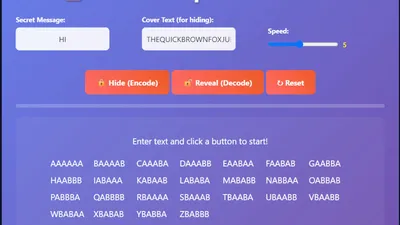
Learn about Bacon's cipher, Francis Bacon's 17th-century biliteral system that hides a secret message not by scrambling it, but by encoding it into which of two typefaces each letter of an innocent-looking cover text uses.

Breaking the Beaufort Cipher

The Beaufort cipher's reciprocal formula (C = K − P instead of Vigenère's C = P + K) looks like it should matter to an attacker. It doesn't: the same Kasiski examination, Index of Coincidence, and chi-squared pipeline that breaks Vigenère breaks Beaufort just as cleanly.

The Bifid Cipher

Learn about the Bifid cipher, Félix Delastelle's fractionating cipher that scrambles a Polybius square's coordinates across an entire message, defeating single-letter frequency analysis far more thoroughly than plain substitution.

The Enigma Machine

Learn how the Enigma machine worked: the WWII German cipher machine that produced a different substitution alphabet for every single keystroke. Its defeat by Alan Turing and Bletchley Park changed the course of the war.

The Four-Square Cipher

Learn about the four-square cipher, a digraph substitution cipher that uses four 5x5 grids to encrypt letter pairs without Playfair's awkward same-row and same-column special cases.

The Nihilist Cipher

Learn about the Nihilist cipher, the 19th-century Russian revolutionary cipher that turns a Polybius square into a polyalphabetic system by adding coordinate numbers together instead of shifting letters.

The One-Time Pad

Learn about the one-time pad, the only cipher in this series that is mathematically proven unbreakable, and why that proof rests on three conditions that are almost impossible to satisfy in practice.

Breaking the Substitution Cipher

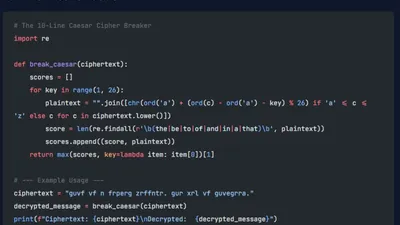
A monoalphabetic substitution key is one arbitrary permutation of 26 letters: 26! of them, far too many to brute force and immune to Kasiski or the Index of Coincidence since there's no repeating key. Here's how frequency analysis and a hill-climbing search crack it anyway.

The Two-Square Cipher

Learn about the two-square cipher, a digraph substitution cipher that sits between Playfair's single grid and four-square's four grids: two independently keyed squares, one uniform encryption rule.